Why Air Fryer Recipe Times Never Match Your Machine (and How to Calibrate It Once)
Quick Answer: Air fryer recipe times fail across machines because wattage, basket geometry, fan speed, and thermostat accuracy all vary widely between models - a 1500-watt basket unit and a 1700-watt oven-style unit cooking the same fries are genuinely different appliances. Calibrate once with a two-part test: bake a single slice of bread to find your hot spots and true browning time, then check the real temperature with an oven thermometer. Write your offset on a sticky note inside a cabinet door and apply it to every recipe from then on.
The recipe says 18 minutes at 400. At 18 minutes yours is pale. Or scorched. Either way you have learned nothing transferable, and next week the same thing happens with a different recipe.
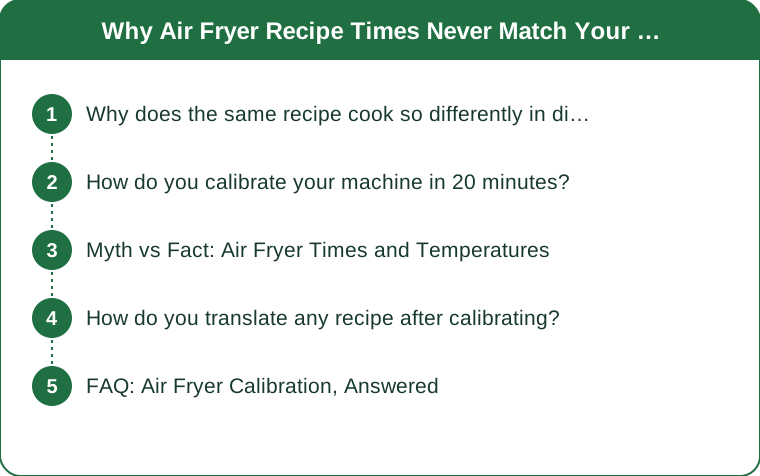
Why does the same recipe cook so differently in different air fryers?
Wattage varies substantially across models. Small basket units commonly run around 1200 to 1500 watts while larger units run 1700 watts or more, and more power in a similar volume means faster browning. A recipe developed on a high-wattage machine will consistently undercook in a lower-wattage one at the same setting.
Basket geometry changes airflow, which is the whole mechanism. Air fryers cook by moving hot air fast across food surfaces. A deep, narrow basket, a wide shallow drawer, and an oven-style cavity with a rack move air differently, so the same food at the same temperature browns at different rates and in different patterns.
Fan speed is not standardized and is rarely published. Two machines rated at the same wattage can differ noticeably in how aggressively they circulate air, which is why one browns evenly and another needs shaking every five minutes.
Thermostats are frequently inaccurate. Consumer testing regularly finds real cavity temperatures differing from the setting, sometimes by a considerable margin in either direction. Your 400 may be someone else’s 370, and no recipe can account for that.
And load size matters more than in an oven. Air fryers have small cavities, so adding food drops the internal temperature proportionally more than it would in a full-size oven. A recipe tested with 300 grams of fries behaves differently with 700 grams in the same basket, which is separate from the crowding issue everyone already knows about.
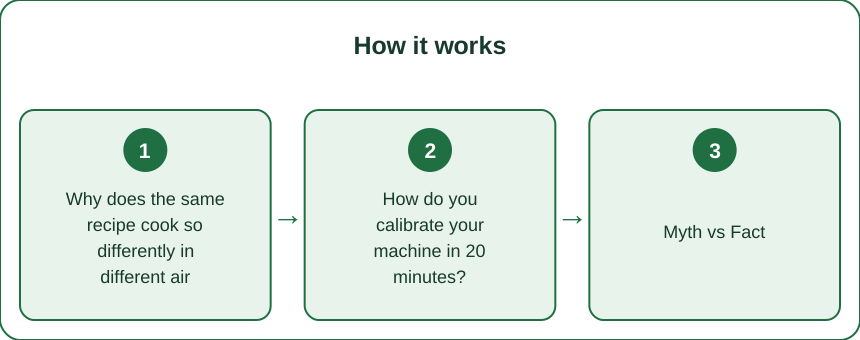
How do you calibrate your machine in 20 minutes?
Two tests, one afternoon, and every recipe afterwards becomes translatable.
Test one: the bread slice map. Lay a single slice of plain white bread flat to cover as much of the basket as possible - cut and arrange two slices if needed. Run at 350 for about four minutes and look at the browning pattern. Where it browns first is your hot zone, and how long it takes to reach an even golden tells you whether your machine runs fast or slow relative to typical recipes. Snap a photo of it; that map explains every unevenly cooked thing you have made.
Test two: the thermometer check. Put an oven-safe thermometer in the basket, run the machine at 350 for 10 minutes, and read it quickly. If it reads 325, your machine runs about 25 degrees cool and every recipe needs that adjustment. If it reads 375, the opposite. This single number is the most useful thing you will learn about your appliance.
Write both results down where you will see them. A sticky note inside the cabinet door above the machine: runs 25 degrees cool, hot spot back right, shake at halfway. That note does more for your cooking than any recipe collection.
Then re-test after any change. A new machine, obviously - but also after a deep clean of a heavily used unit, since accumulated grease on the heating element genuinely affects performance.
One caution on the thermometer test: read it fast, because opening the basket drops the temperature quickly. Take the reading within a couple of seconds of opening.
Myth vs Fact: Air Fryer Times and Temperatures
Myth: Air fryer recipes are standardized like oven recipes. Fact: They are not standardized at all. Recipe developers test on their own machine, and the variation between consumer models in wattage, airflow, and thermostat accuracy is far wider than between conventional ovens.
Myth: The rule is always reduce oven temperature by 25 degrees and cut time by 20 percent. Fact: That conversion is a reasonable starting point for adapting oven recipes, not a precise rule - and it is useless if your machine’s thermostat is already off by 25 degrees in one direction or the other. Calibrate first, then apply conversions.
Myth: Preheating does not matter in an air fryer. Fact: It matters most for foods where surface browning is the point, and much less for foods cooking through slowly. A machine that has not preheated is effectively running a lower temperature for the first several minutes, which is a common hidden cause of pale results.
Myth: A bigger air fryer just cooks more of the same thing. Fact: Larger cavities usually mean different airflow patterns and often a different browning character. Recipes that were dialed in on a small basket often need adjusting when you upgrade, which surprises people who expected a straight scale-up.
Myth: If food is not crisping, the temperature is too low. Fact: More often it is surface moisture, crowding, or too little oil. Raising the temperature on wet, crowded food produces something scorched outside and steamed inside.
How do you translate any recipe after calibrating?
Apply your offset to the temperature first. If your machine runs 25 degrees cool, set 425 when a recipe says 400. This one adjustment resolves the majority of mismatches by itself.
Then check early rather than trusting the time. Set a timer for 70 percent of the stated time and look. Air fryer cooking moves fast at the end, and the gap between perfectly golden and too dark can be 90 seconds.
Adjust for load, not just for the recipe. If you are cooking more than the recipe specifies, add time rather than temperature and shake more often. If you are cooking less, expect it to be done early.
Rotate for your hot spot. If your bread map showed the back right browning first, turn the basket contents at the halfway shake rather than just tossing them. Same effort, better result.
Use internal temperature for anything where it matters. For proteins, a instant-read thermometer removes all of this guesswork - 165 for chicken, whatever your usual standard is for other proteins. Time and appearance are proxies; internal temperature is the actual answer.
Keep a two-line log for repeat meals. Frozen fries: 400 for 14, shake at 7. Chicken thighs: 380 for 22, flip at 12. After about a month of favorites, you stop needing recipes for weeknight food entirely - which is the real payoff of calibrating once.
FAQ: Air Fryer Calibration, Answered
Why does my air fryer cook slower than the recipe says?
Most likely a combination of lower wattage than the recipe developer’s machine and a thermostat reading higher than the true cavity temperature. Check with an oven thermometer at 350 and apply the difference as a permanent offset to every recipe.
How do I find the hot spots in my air fryer?
Cook a single slice of plain bread flat in the basket at 350 for around four minutes and look at the browning pattern. Wherever it darkens first is where you should rotate food away from at the halfway point.
Do I need to preheat my air fryer?
For foods where crisp exterior is the goal, yes - a few minutes makes a real difference, and skipping it effectively means cooking at a lower temperature for the first stretch. For longer, slower cooks it matters much less.
How do I convert an oven recipe to an air fryer?
Start by reducing the temperature by about 25 degrees and the time by roughly 20 percent, then apply your machine’s own calibration offset on top and check early. Air fryer surfaces brown much faster than oven surfaces, so the first check should come well before the calculated time.
TL;DR:
- Recipe times fail across machines because wattage, basket geometry, fan speed, and thermostat accuracy all vary widely and none of it is standardized.
- Calibrate once: a bread slice at 350 for four minutes maps your hot spots, and an oven thermometer at 350 gives you a temperature offset.
- Write the offset and hot spot on a sticky note inside the cabinet door and apply it to every recipe from then on.
- Check at 70 percent of the stated time, adjust for load with time rather than temperature, and rotate toward your known hot spot at the shake.
- Use an instant-read thermometer for proteins and keep a two-line log for repeat meals - after a month you will not need recipes for weeknight food.
Your air fryer is not broken and the recipe was not wrong. They were written for two different appliances, and twenty minutes of calibration is what translates between them permanently.
Keep Reading
This article is for general informational purposes only and is not medical advice. Always consult a qualified health professional for guidance specific to you.